


The UK open relationship community isn’t just thriving – it’s growing and, dare we say, evolving. For gay and trans individuals, this vibrant lifestyle has opened up a new frontier, offering both opportunities and challenges. Interestingly, the open relationship scene, with its emphasis on open-mindedness and exploration, shares common ground with the struggles faced by gay and trans communities, making it well-positioned to foster inclusivity.
In this piece, we’ll dive into how gay and trans dating has carved a place within the blossoming UK open relationship lifestyle, why the gay community may already be more primed for non-monogamy than straight couples, the specific challenges LGBTQ+ members face — both from the outside and within their own relationships — what real inclusion looks like in practice, and how UK media has responded, whether by celebrating or overlooking their presence.
The Swinger Community and LGBTQ+ Connection
No one can truly grasp the challenges faced by a unique individual or group unless they’ve walked in their shoes. But shared experiences and common struggles can go a long way in fostering understanding and solidarity.
The swinger community has long been painted with the wrong brush. It’s been sensationalised in the media, misunderstood by those who cling to more mainstream relationship norms, and unfairly targeted by narrow-minded politicians keen to pass judgment.
Sound familiar?
For members of the gay or trans community, this script is all too recognisable. Misrepresentation, discrimination, and societal pushback are threads woven through the histories of both LGBTQ+ and swinger communities. Whether it’s the scorn of a stranger or the wrath of a politician eager to weaponise morality, both groups have faced their fair share of bullying and judgment.
These shared challenges create an unexpected but meaningful bond. Both swingers and LGBTQ+ individuals often find themselves fighting the same fight — challenging stereotypes, advocating for understanding, and carving out spaces where they can simply exist without the weight of societal scorn.
It’s worth asking: is the gay community actually more open to non-monogamy than straight couples? To some extent, likely yes. Many gay couples have already navigated criticism and societal pressure simply for being true to themselves — and having done that groundwork, embracing an alternative relationship structure like swinging can feel like a natural extension of a journey toward self-expression, rather than an entirely new frontier. Straight couples, by contrast, are often encountering relationship-based judgment for the first time when they step into non-monogamy, without that same shared history to draw on.
Gay male non-monogamy also tends to look different in practice than the traditional “couples-only swinger club” model. Many gay men move fluidly between open relationships, casual cruising, threesomes and group play, and polyamory, often without ever using the label “swinger” at all. That fluidity is part of what makes LGBTQ+ spaces, at their best, more receptive to sexual exploration than some mainstream lifestyle scenes — discussing non-monogamy within LGBTQ+ social circles often draws far less shock than it would in more traditional straight social settings.
By recognising these commonalities, the UK’s swinger scene has an opportunity to build an environment where all are welcome — regardless of who they are, who they love, or how they choose to explore connection and intimacy.
The Challenges for Gay and Trans People in Swinger Spaces
Now that we’ve established the connection between gay and trans dating communities and swingers through their shared struggles, it’s time to take a closer look at the specific obstacles LGBTQ+ individuals may face — both from the wider community, and within their own relationships.
External barriers
For many gay and trans people, entering a space predominantly shaped by heterosexual norms can feel daunting.
- Misgendering. Whether intentional or accidental, misgendering can be deeply hurtful and creates an immediate barrier to feeling safe and accepted. Correct pronoun use and a willingness to be corrected are the baseline for a respectful space, not an optional extra.
- Stereotypes and assumptions about trans bodies. The swinger community’s exploratory, sexually open culture can sometimes tip into problematic assumptions about a trans person’s body or preferences before they’ve even had the chance to define themselves. These assumptions can feel dehumanising rather than curious.
- Fetishisation of gay couples. Gay couples may encounter the expectation that their participation should cater to the fantasies of heterosexual couples, reducing their identity to entertainment rather than treating them as equals within the community.
- Bisexual men navigating a double standard. Female bisexuality is often encouraged and expected within swinger spaces, while male bisexuality or gay male play is frequently met with discomfort or taboo. Some bi men choose to keep their orientation private on lifestyle platforms simply to avoid a cooler reception.
- Nonbinary erasure in club structures. Many venues still price entry, set ratios, or frame policies around a strict male/female binary, which leaves nonbinary members without a clear place in the system. Attitudes that reduce a person to their anatomy rather than treating them as a whole person compound this — it’s less about ill intent and more about club structures that haven’t caught up.
- Representation gaps. LGBTQ+ members may struggle to see themselves reflected in event marketing, club policies, or media coverage. When everything assumes heteronormativity by default, it sends an unintentional but clear message: “you’re not the norm here.”
Internal relationship dynamics
Beyond external bias, gay couples exploring non-monogamy also navigate a set of internal challenges that deserve just as much attention:
- Jealousy. Entering the lifestyle doesn’t erase possessiveness — for some gay couples, especially those carrying past experiences of infidelity or betrayal, swinging can bring jealousy to the surface in intense ways. Open, honest communication and clear boundaries set early are what make the difference.
- Trust. Couples who’ve previously experienced social exclusion or rejection may approach non-monogamy with extra apprehension, wary of feeling even more misunderstood within their existing social circles. Building trust deliberately is what allows swinging to strengthen a relationship rather than strain it.
- Stigma from within the community. Not every gay couple sees non-monogamy as compatible with their values — some hold more traditional views and see monogamy as the goal, which can mean facing judgment from peers as much as from outsiders. Finding like-minded people who share a similar outlook matters as much here as it does with the wider swinger scene.
- Power dynamics. Without the traditional gender-role expectations that can shape hetero dynamics, power dynamics in gay relationships tend to be more fluid — but questions of dominance and submission don’t disappear, and can become more complex once additional people are introduced. Naming these dynamics openly, rather than assuming they’ll sort themselves out, helps everyone involved feel comfortable and respected.
These challenges aren’t insurmountable, but they do require intentional action from swinger communities — and from couples themselves — to move past them.
What an Inclusive Swinger Space Actually Looks Like
Creating genuine safety and inclusion for gay and trans members starts with intention and follow-through, not just good intentions. Clubs and events that get this right tend to share a few things in common:
- Clear, published policies. Anti-discrimination policies that explicitly name and protect trans and gay members set the tone before anyone even walks in the door.
- Staff and organiser training. Regular training on LGBTQ+ inclusion means staff can confidently address issues, correct guests, and uphold the club’s stated values — rather than leaving it to chance.
- Gender-neutral facilities. Something as simple as gender-neutral restrooms and changing areas can make a meaningful difference to how comfortable trans guests feel.
- A genuine consent culture. No one should feel obligated to answer invasive personal questions or participate in interactions they’re not comfortable with — reinforcing this openly protects everyone.
Some UK clubs are already setting the standard. Hellfire has built a reputation for a respectful, open-minded atmosphere that welcomes people from all walks of life (read our Hellfire review), while Le Boudoir has similarly earned a name for an elegant, inclusive environment (read our Le Boudoir review). Both demonstrate that inclusivity and a high-quality experience aren’t mutually exclusive — if anything, they reinforce each other.
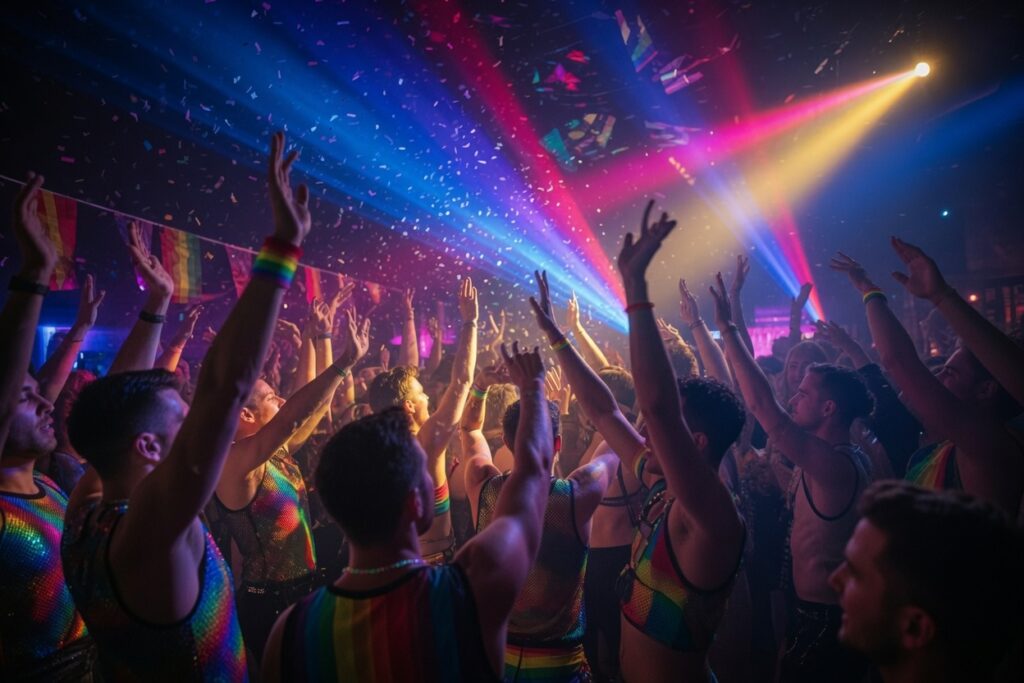
Beyond individual venues, allyship matters at every level of the community: normalising respectful language, speaking up when discrimination happens rather than staying quiet, and supporting peer networks where gay and trans members can share experiences and advice with people who understand their specific context.
Inclusive spaces beyond London
While London remains the hub most people think of first, inclusive venues and events exist across the UK — it’s just a matter of knowing where to look. She.world and Sweet Wednesday in London are worth seeking out alongside Hellfire and Le Boudoir, while Pink Punters in Milton Keynes has built a strong reputation outside the capital. In Birmingham, community groups like Outskirts offer a lower-pressure entry point for gay and trans people who want to connect with like-minded locals before stepping into a full club or party setting.
Checking for themed nights — such as pansexual or trans-focused evenings — is one of the simplest ways to gauge whether a venue is genuinely inclusive rather than just claiming to be. As always, it’s worth confirming a venue’s current policies directly before attending, since scenes and management can change.
Media Challenges — and Where Representation Is Actually Happening
When it comes to media, there’s always the good – and the bad.
For gay, trans, and swinger communities, the divide in how they’re represented is as wide as it is complex. In the UK, mainstream media has often failed to adequately or fairly portray these groups. Swingers, in particular, are either ignored altogether or reduced to caricatures — exotic oddities rather than people embracing an alternative lifestyle by choice. Representation of gay and trans communities has genuinely improved over the years, but there’s still plenty of room for growth, especially when it comes to nuanced, authentic portrayals that steer clear of stereotypes.
So where have these communities found a sense of solace and belonging? Independent media.
It’s no surprise, really. Podcasts, blogs, and grassroots content creators are often the ones leading the charge when it comes to inclusivity, creating space for honest conversations and diverse voices that mainstream outlets continue to overlook. In the UK swinger scene, a handful of independent podcasts stand out for championing representation:
- bed hoppers – swinging in the UK — dives into the world of swinging through the lens of a UK couple, with candid discussion and a genuinely welcoming tone.
- Swing Bi The Podcast — tackles bisexuality and swinging directly, shining a light on how non-traditional relationships can thrive, and making it a valuable resource for LGBTQ+ members of the swinger community.
- Torrid Souls and Sapphic Swingers — both spotlight same-sex female swinging experiences specifically, filling a gap that mainstream coverage rarely touches.
These independent voices prove that representation doesn’t have to wait for mainstream acceptance. They show that with the right platform and passion, the stories of gay, trans, and swinger individuals can be told in a way that’s empowering, respectful, and real.
Approaching the Lifestyle Safely
Whatever your identity or relationship structure, a few fundamentals hold true for anyone exploring non-monogamy: prioritise open communication with your partner before you prioritise anything else, agree on boundaries in advance rather than in the moment, and take sexual health seriously — that means regular STI testing and, where relevant, discussing PrEP as part of a broader safety conversation. None of this dampens the exploration; if anything, it’s what makes it sustainable.
Gay and trans swingers can connect on Group Fun, a prominent UK swinger site that’s blissfully inclusive.
Ready to Meet Real Members Near You?
Join the UK’s top free and inclusive lifestyle community — where swingers, adventurous couples, open-minded singles and curious groups connect. No fake profiles. No hidden fees. Just real people and real fun.
Join Free — Let Me In!