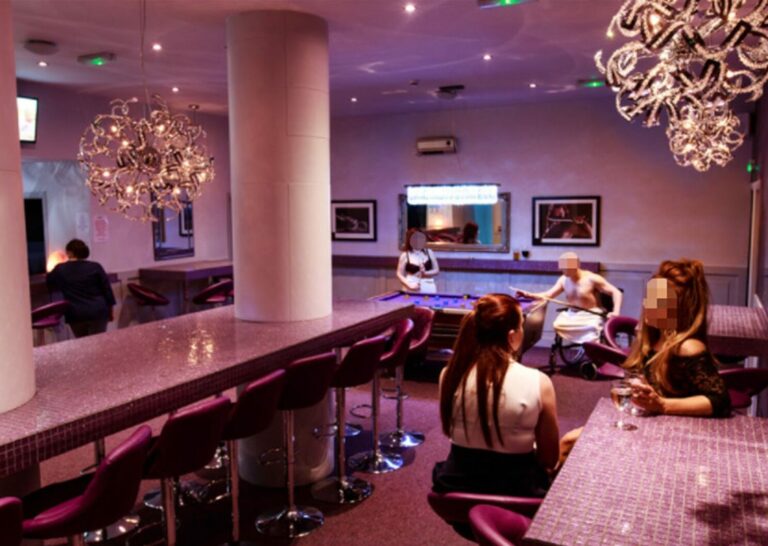


There’s a specific, deflating moment many queer women face when exploring the UK swinging scene. You stumble upon a club website with a rainbow flag in the corner and a welcoming tagline, but then you hit the entry policy:
Couples £50. Single ladies £30. Single men, guest list only.
Nowhere does it specify if a “couple” can mean two women. For lesbian swingers UK, that gap between marketing and reality is the real story. Queer women are here, but the challenge is figuring out which rooms were actually designed with them in mind.
What “Couples only” Really Means at UK Swingers Clubs?
Let’s be blunt: “couples only” often means one man and one woman.
Plenty of UK swingers clubs list entry prices for M+F or M+F+F couples only. If that’s where the list stops, you have your answer. Door staff may mistake two women arriving together for two single entrants, which can mean paying more and being treated differently once inside. Major swinger cruises and weekend takeovers can be stricter, with mixed-pairing requirements that sapphic couples simply can’t meet.
Venues that get this right leave little room for guesswork. An explicit F+F tier, priced the same as M+F couples, tells you immediately where you stand.
Finding Genuinely Inclusive Clubs
The good news? The list of inclusive spaces is growing and some examples include:
Hellfire Club (West London): This established lifestyle venue runs dedicated queer nights rather than treating identity as an afterthought. Always check the calendar before heading out.
Swindon Swingers (Wiltshire): Its monthly REMIX night explicitly welcomes all genders, sexualities and body types. Pricing is also flat: M+F, F+F, single women and single men all pay £40 early or £50 later. This is the clearest example in the country of a club writing inclusion into its actual policy rather than its branding.
London’s dedicated nights: Organisers regularly host women only swingers nights and mixed-female events across the capital, including Shirts n Heels, Galentines and Mint Fever. By restricting or excluding single men, these nights offer an alternative to a male-dominated room.
Regional daytime socials: Across the Midlands and North, smaller venues sometimes host private, invite-only lesbian afternoons. Because these aren’t always advertised publicly, local mailing lists and direct enquiries can be useful.
If you are a lesbian swinger looking for a welcoming venue, the details matter a lot more than the rainbow logo.
The Bisexual Double Standard
Bisexual and pansexual women are welcomed with open arms by mainstream swinging spaces. While women playing with women is often encouraged, it can also become the performative entertainment portion of the night. For some, that’s freeing and fun but for others, it quickly feels like an act staged for guys to gawk at.
Being bi or fluid isn’t a blanket card of consent. It doesn’t mean a woman wants an audience, nor does it mean she’s available to everyone in the room.
For lesbians, the dynamic creates a distinct barrier. The mainstream swinging lifestyle has carved out considerable space for women who play with women within a mixed-couple framework, but much less for those only interested in women. That’s why queer women swinging UK communities are looking towards identity-first events.
Sapphic Play Parties in the UK: The Private Scene

Alongside traditional brick-and-mortar clubs is a network of sapphic play parties UK. These aren’t public commercial venues. They’re private, vetted, ticket-capped events run by independent collectives.
Skirt Club: A large international private members’ network hosting men-free themed parties across major UK cities. It has a following, although some in the community feel its branding leans heavily toward straight-curious or cis-bisexual dynamics.
Lilith’s Lair (Brighton): A small, intimate men-free and kink-positive party series in Kemp Town for queer, bi, pan and curious women and femmes. Numbers are capped at around 50, with icebreakers and clear verbal consent discussions before the evening begins. Kink attire or comfortable clothes, both are fine; nudity is welcomed but never assumed. Vetting is handled through their social channels, so you’ll need to make contact before tickets.
Club Fukk (London): Operating since 2004 through the Wotever World crew at The Hoist, this established night was created as an alternative to more heteronormative fetish parties. Its crowd includes non-binary, polyamorous and queer people, with pre-party workshops. It runs five or six times a year, far and away the best entry point for a nervous newcomers.
How Do You Actually Get In?
If you’re looking for sex positive events UK, you can’t always just Google them and buy a ticket. Private events are intentionally kept low-key to prevent uninvited guests from turning up.
- Embrace the vetting: Expect applications, ID checks or even video screenings. It may feel like a hurdle, but it helps keep the space secure.
- Go to munches first: A munch is a casual, fully clothed social gathering at a pub or café. It’s completely non-sexual and gives people a chance to chat and meet organisers.
- Use identity-first apps: Older couple-centric sites often assume a male-female pairing by default. Newer, more fluid apps can be better for finding bi friendly swingers clubs and queer collectives.
What to Expect on Your First Night
Your first visit will probably be more casual—and less dramatic—than you expect.
Financially, expect around £30 to £50 for entry at standard venues, with lockers sometimes costing about £5. Private collectives may cost more because capacities are limited on purpose.
Rules are generally strict but simple. Expect a zero-tolerance phone policy at many venues, with screens put away to protect everyone’s privacy. Dress codes can also matter whereby basic streetwear or jeans may get you turned away.
Most importantly, nobody will touch you without explicit permission. At properly managed ladies only nights, boundaries should be established openly and respected. You’re in control of your own night.
The Trans Inclusion Fault Line
It’s impossible to discuss the swinger scene honestly without recognising the divisions within it. Some trans women report being welcomed at the front door of women-only nights, only to encounter a different atmosphere once inside. Some commercial events remain explicitly trans-exclusionary, which has prompted pushback within the wider community.
Other venues take a clearly different approach. SHE Soho in central London welcomes trans people, Pop-Up Dyke Bar is trans-led, while collectives such as Lick focus on trans, non-binary and queer people of colour. Always read the fine print before booking so you don’t get any bad surprises.
Beyond the Swinging Scene: Lesbian Club nights
Queer women’s nightlife doesn’t exist entirely inside lifestyle clubs. In London, the scene includes permanent lesbian bars such as La Camionera, alongside established nights and events like Butch, Please!, Lick and Fèmmme Fraîche. These aren’t necessarily swinging venues, but they can be good places to meet people and get a feel for the wider community.
For example, Butch, Please! has run since 2015 and outgrew the Royal Vauxhall Tavern so thoroughly it now fills the 1,250-capacity Clapham Grand monthly — the biggest sapphic night in the UK. Lick is one of Europe’s biggest sapphic parties, taking over Ministry of Sound, Electric Brixton and Studio 338, and now runs its own venue near Vauxhall.
Gal Pals splits regular nights between King’s Cross and Brighton. Fèmmme Fraîche has been Dalston Superstore’s longest-running queer women’s night since 2015, trash-pop upstairs and techno in the basement. Pxssy Palace remains the essential QTIBIPOC night, with free taxis home for disabled guests. Leztopia covers house, techno and acid across Peckham, Dalston and Hackney Wick. Pop-Up Dyke Bar takes over ordinary pubs twice a month, free entry, no booking. Carabiner at the Royal Vauxhall Tavern, Strapped, WET, G.IRL, Mint London and the touring U-Haul Dyke Rescue Mobile Dyke Bar fill out a calendar that barely existed five years ago.
Outside the capital, things vary even more. Manchester has fewer dedicated venues for queer women (for example Vanilla in The Gay Village is long known as the lesbian mecca of the north), so social groups centred around running, climbing and book clubs have become an important part of the scene. Brighton has one of the country’s strongest sapphic communities, while smaller places such as Oxford (The Jolly Farmers) and Hebden Bridge have developed their own networks.
So, Can Lesbian Swingers UK Find Their Community?
For sure. The mainstream landscape is shifting, and venues that offer an equal F+F line on their pricing make their position much clearer. Meanwhile, the private sapphic circuit is thriving, offering smaller, consent-focused spaces.
It can take patience to get vetted and build up a network but for lesbian swingers in the UK, finding the the right crowd makes the experience very different from simply turning up at a club and hoping for the best.
For anyone exploring LGBTQ+ dating in UK and LGBT swingers clubs UK options, the key is to look beyond the label. Check the entry policy, ask questions and find out whether a venue genuinely caters to queer women or simply uses inclusive language in its marketing.