

Talking to your partner about an open relationship, swinging, or any form of consensual non-monogamy should never feel like a sales pitch.
The goal is not to convince them, pressure them, or move the relationship toward something before both of you are ready. The goal is to open an honest conversation where both partners feel safe enough to talk about curiosity, boundaries, fears, trust, and what the idea actually means.
That is why this conversation matters so much.
Non-monogamy can touch sensitive parts of a relationship: attraction, commitment, jealousy, emotional security, privacy, intimacy, and identity. Even if your curiosity comes from a healthy place, your partner may not hear it that way at first. They may wonder whether something is missing, whether you are unhappy, or whether this changes how you feel about them.
So the way you bring it up matters just as much as the topic itself.
This guide explains how to talk to your partner about exploring non-monogamy with honesty, empathy, and respect. It applies whether you are curious about swinging, open relationships, or simply learning more about consensual non-monogamy together.
Table of Contents
What Does Exploring Non-Monogamy Mean?
Exploring non-monogamy does not always mean the same thing for every couple.
For some people, it means learning about open relationships. For others, it may mean talking about swinging, attending social lifestyle events, creating a profile on a community site, or simply reading about what other relationship structures look like.
It may also mean deciding that none of those options are right for your relationship.
That is still a valid outcome.
Before you talk to your partner, it helps to understand the difference between three common ideas:
- Open relationships usually involve a relationship agreement where partners may have romantic, sexual, or dating connections outside the primary relationship, depending on the boundaries they set.
- Swinging usually refers to couples exploring social or physical experiences with others, often in a shared or community-based lifestyle context.
- Consensual non-monogamy is the wider umbrella term for relationship structures where everyone involved knows about and agrees to the arrangement.
The exact definitions can vary, which is why the first conversation should not begin with assumptions. It should begin with clarity.
You are not asking your partner to agree to everything at once. You are asking whether the two of you can talk honestly about the idea.
Why This Conversation Feels So Difficult
If you feel nervous about bringing up non-monogamy, that is completely understandable.
This is not the same as suggesting a new restaurant or planning a weekend away. You are raising a topic that can touch deep emotional questions in a relationship. Even confident couples can find the conversation awkward at first.
The fear usually comes from what the question might imply.
Your partner may wonder:
- Are you unhappy with me?
- Are you no longer attracted to me?
- Have you already made up your mind?
- Are you asking for permission or making an announcement?
- Is there someone specific you have in mind?
- Is this going to change our relationship?
- What happens if I say no?
Those fears do not mean the conversation is wrong. They simply mean it needs care.
The mistake many people make is focusing only on what they want to say. A better approach is to think about how your partner might feel when they hear it. That does not mean you should hide your curiosity. It means you should introduce it in a way that protects emotional safety.
If your partner feels reassured, respected, and free to respond honestly, the conversation has a much better chance of staying healthy.
With that emotional context in mind, the safest approach is simple: start gently, make room for their feelings, and do not ask for a decision immediately.
Quick Answer: How Do You Talk to Your Partner About Non-Monogamy?
The best way to talk to your partner about non-monogamy is to choose a calm, private moment, reassure them that your relationship matters, explain your curiosity without trying to persuade them, and invite their honest feelings. Make it clear that you are not asking for an immediate decision and that their comfort matters more than the idea itself.
A good opening could sound like this:
“I want to talk about something honestly, and there is no need to decide anything today. I have been curious about the idea of open relationships and consensual non-monogamy, not because anything is missing between us, but because I trust you enough to talk about it openly. I would like to know how you feel about it.”
Or, if your curiosity is specifically about swinging:
“I have been curious about the swinging lifestyle, but I do not want to rush anything or make assumptions. I am not saying we should do anything. I just wanted to talk to you honestly and hear how it feels for you.”
That kind of approach keeps the conversation respectful. It also makes clear that this is a discussion, not a demand.
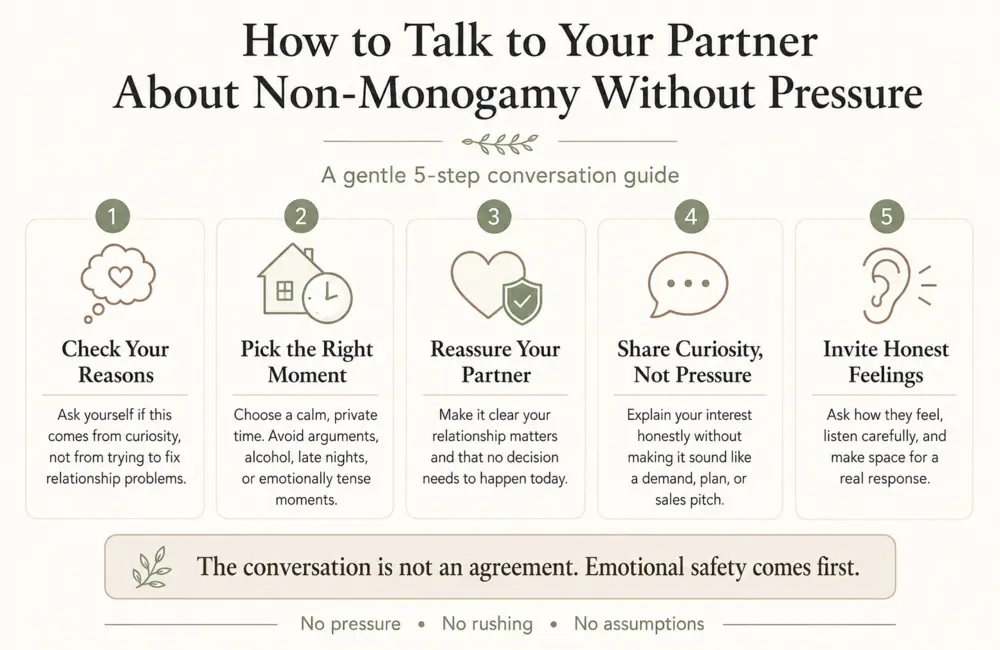
Ask Yourself Why You Are Curious First
Before thinking about what you will say, it is worth understanding what has sparked your curiosity in the first place.
Curiosity vs Relationship Problems
Curiosity about open relationships or swinging does not automatically mean something is wrong with your relationship.
Some people are curious because they have read about consensual non-monogamy and want to understand it better. Others are interested in shared exploration, meeting like-minded people, talking more openly about boundaries, or learning how other couples build trust.
That is very different from using non-monogamy to avoid a relationship problem.
If the real issue is poor communication, unresolved resentment, broken trust, boredom, or feeling disconnected, opening the relationship is unlikely to fix it. In fact, it can create more pressure if the relationship foundation is already unstable.
A simple self-check helps:
“Am I curious because I want to explore something with my partner, or because I am trying to escape something in the relationship?”
Healthy Reasons to Explore the Conversation
Healthier reasons usually involve openness, communication, and shared curiosity.
For example:
- You want to discuss a fantasy honestly.
- You are curious about consensual non-monogamy and want to learn together.
- You feel secure in your relationship and want to talk about new possibilities.
- You want to understand whether this is something you might both be interested in.
- You are interested in the social side of the lifestyle, not only the physical side.
- You want to talk more openly about boundaries, trust, and desire.
None of these reasons guarantee that an open relationship or swinging is right for you. They simply create a better foundation for a respectful conversation.
Reasons That Usually Lead to Problems
Some motivations are more likely to cause harm.
Be careful if your reason sounds like:
- “This will fix our relationship.”
- “My partner needs to become more open-minded.”
- “I am bored, and this will solve it.”
- “If they love me, they should agree.”
- “I already know what I want, and I need them to accept it.”
- “I want to make them jealous.”
- “Other couples do this, so we should too.”
Those thoughts do not create emotional safety. They create pressure.
The first conversation should not begin with a decision already made. It should begin with curiosity and a willingness to hear your partner fully.
Choose the Right Time to Bring It Up
Timing can change the entire tone of the conversation.
Timing will not determine your partner’s answer, but it can influence whether they feel safe enough to hear the question. Even a carefully worded conversation can land badly if it comes during stress, conflict, insecurity, or distraction.
When Not to Have the Conversation
Avoid bringing up the topic:
- during an argument
- after one partner has felt rejected
- when either of you has been drinking
- during jealousy or insecurity
- when you are about to go to sleep
- when one person is rushing out
- during an emotionally tense period
- as a reaction to intimacy problems
- immediately after meeting someone you are attracted to
This deserves more thought than a passing comment.
Create a Relaxed Environment
Choose a calm, private time when you can both talk without interruption.
That might be during a quiet evening at home, a relaxed weekend morning, or a moment when you are already having an open conversation about your relationship.
You do not need to make it overly formal. In fact, making it too serious can increase anxiety. The aim is simply to create enough space for both of you to think, ask questions, and pause if needed.
A useful way to begin is to ask for permission to raise a sensitive topic:
“Can I talk to you about something a bit personal? There is no need to decide anything today. I just want to be honest and hear how you feel.”
How to Start the Conversation
The first few sentences matter.
They set the emotional tone. If your partner hears dissatisfaction, urgency, or an expectation that they should agree, they may become defensive. If they hear reassurance, care, and openness, they are more likely to listen.
Conversation Examples
You might say:
“I have been reading a little about open relationships, and I realised I am curious about the topic. I do not want to rush anything, and I am not saying we should do it. I just wanted to talk to you honestly and hear how you feel.”
Or:
“This is a sensitive topic, so I want to say first that I love our relationship. I have had some curiosity about consensual non-monogamy, and I would rather talk to you openly than keep it in my head. There is no expectation around this at all.”
Or:
“I came across something about swinging, and it made me wonder how couples even talk about it. I am curious what your thoughts are, even if the answer is that it is not for us.”
These examples work because they do three things:
- reassure the relationship
- explain curiosity without expectation
- invite your partner’s view
Gentle Ways to Introduce the Topic
You do not have to start with “I want an open relationship” or “I want to swing.”
That can sound too direct for a first conversation, especially if your partner has never thought about it before.
Softer introductions include:
- “How do you feel about couples who explore consensual non-monogamy?”
- “Would you ever be open to reading about swinging or open relationships together, just to understand it?”
- “I am curious about the topic, but I do not want to assume anything. How does it make you feel?”
Being gentle does not mean being dishonest. It means being emotionally considerate.
Ask Questions Instead of Making Statements
A question invites conversation. A statement can sound like a decision.
Instead of:
“We should try an open relationship.”
Try:
“How would you feel about talking more about open relationships?”
Instead of:
“I want us to do this.”
Try:
“I have been curious about it, but your feelings matter more than the idea.”
Instead of:
“You need to be more open-minded.”
Try:
“I know this might feel unexpected, and I want to understand your reaction.”
The more room you give your partner to respond honestly, the safer the conversation becomes.
What to Say and What Not to Say
The wrong phrasing can make your partner feel compared, pressured, or rejected. The right phrasing can make them feel respected, even if the topic is uncomfortable.
| Supportive Approach | Unhelpful Approach |
| “There is no need to decide today.” | “You need to be open-minded.” |
| “Your feelings matter more than the idea.” | “Everyone else is doing it.” |
| “If this is not for us, that is okay.” | “If you loved me, you would consider it.” |
| “I want to talk, not rush.” | “We should just try it once.” |
| “I am curious, but I care how this feels for you.” | “You are overreacting.” |
Helpful Phrases
Use language that reassures rather than persuades.
Helpful phrases include:
- “I am not asking for an answer right now.”
- “I care more about our trust than about trying anything.”
- “Your no would be respected.”
- “We can move entirely at our own pace.”
- “Curiosity does not mean we have to act on it.”
- “Learning more does not mean agreeing to anything.”
These phrases make it clear that your partner has real choice.
Phrases That Create Pressure
Avoid anything that sounds like guilt, comparison, or emotional manipulation.
Do not say:
- “If you loved me, you would try it.”
- “You are too insecure.”
- “Other couples do this.”
- “You are boring.”
- “It is just one time.”
- “You will like it once you try it.”
- “I have already decided I want this.”
Even if said casually, phrases like these can damage trust.
Avoid Ultimatums
An ultimatum turns a conversation into a threat.
Non-monogamy should never be framed as something your partner must accept to keep the relationship secure. That creates fear, not openness.
If your partner says no, the answer should be respected. You may feel disappointed, but disappointment is not a reason to punish them, withdraw affection, or keep pushing.
A respectful conversation protects both people.
How to Respond to Different Reactions
Your partner’s first reaction may not be their final feeling.
They may need time. They may have questions. They may feel hurt before they feel curious. They may say no immediately.
Your job is not to manage their reaction into the answer you want. Your job is to listen.
If Your Partner Is Curious
If your partner seems interested, move slowly.
Curiosity is not consent. It is only an opening for more conversation.
The next step might be reading beginner guides together, talking about what feels appealing or uncomfortable, or discussing what boundaries would matter most.
Do not rush from “we can talk about it” to creating profiles, contacting other people, or attending an event. Those are very different stages.
If Your Partner Is Surprised
Surprise is normal.
Your partner may need a moment to understand what you are asking and why. They might ask direct questions such as:
- “Does this mean you are unhappy?”
- “Have you wanted this for a long time?”
- “Are you attracted to someone else?”
- “Have you already done something?”
- “Is this about someone specific?”
- “What exactly are you asking for?”
Answer calmly and honestly.
Reassure them without becoming defensive.
If Your Partner Immediately Says No
A clear no should be respected.
You can ask if they are comfortable explaining how they feel, but do not treat their answer as the start of a debate.
A respectful response might be:
“Thank you for being honest. I do not want you to feel pushed. Our relationship matters more to me than this idea.”
That kind of response protects trust.
It also proves that you meant it when you said their answer would be respected.
If They Need Time to Think
A maybe is not permission.
It means your partner needs space to process. Give them that space.
You might say:
“Take all the time you need. We do not have to decide anything. I just wanted us to be able to talk honestly.”
Do not bring it up every day. Do not keep sending articles unless they ask. Let the conversation breathe.
Respecting Boundaries
Once the topic is open, boundaries become essential.
If swinging specifically is what you’re proposing, it helps to already know the difference between soft swap and full swap before that conversation happens, so you’re using the same vocabulary.
This applies whether you are only talking, reading together, joining an online community, discussing swinging, or thinking about a more open relationship structure.
Consent Always Comes First
Consent is not only about what happens later. It starts in the conversation itself.
Your partner should feel free to say:
- “I do not want to talk about this right now.”
- “I need time.”
- “I am curious, but nervous.”
- “I do not want this.”
- “I am open to learning, but not participating.”
- “I am comfortable talking about open relationships, but not swinging.”
- “I am comfortable learning about swinging, but not interested in anything physical.”
All of those responses are valid.
Why “No” Must Be Respected
Respecting no is one of the most important parts of communication around non-monogamy.
If your partner says no and you continue trying to persuade them, the conversation stops being honest and becomes pressure.
A healthy relationship can survive one partner being curious and the other not being interested. It is much harder to repair the damage caused by ignoring a boundary.
Keep Trust Intact
The conversation should leave your partner feeling that they can trust you more, not less.
That means:
- no secret planning
- no hidden profiles
- no contacting others behind their back
- no using the conversation as leverage
- no pretending to accept a no while planning to raise it repeatedly
- no pressuring your partner to read, join, attend, or try anything before they are ready
Trust is the foundation. Without it, nothing should move forward.
If You Both Want to Learn More
If your partner is open to continuing the conversation, the next step is education, not action.
Agreeing to learn more is not the same as agreeing to participate.
Research Together
Start with beginner-friendly resources.
You might read about what consensual non-monogamy means, how swinging differs from open relationships, how boundaries work, what good etiquette looks like, and how privacy and consent are handled in different communities.
Learning together keeps the topic shared. It also prevents one partner from becoming the “expert” while the other feels dragged along.
Set Expectations
Talk about what each of you actually means by curiosity.
One person may imagine simply reading and discussing. Another may imagine creating a profile. Someone else may think curiosity means attending a social event. Another may imagine a much broader open relationship structure.
Clarify the stage you are really in.
Helpful questions include:
- Are we only talking right now?
- Are we open to reading together?
- Would we ever consider joining an online community?
- Would we want to attend a social event just to observe?
- Are we talking about swinging, an open relationship, or both?
- What would feel too fast?
- What would feel completely off-limits?
Clear expectations reduce misunderstandings.
Discuss Boundaries Before Anything Else
Before profiles, events, clubs, dating apps, or meeting anyone, talk about boundaries.
This might include:
- emotional boundaries
- privacy boundaries
- social boundaries
- online communication
- sexual health expectations
- what you would not want to happen
- how either person can pause the process
- how you would check in with each other
Boundaries are not there to make the conversation heavy. They are there to make it safe.
Common Mistakes Couples Make
Most mistakes happen when people rush, avoid honesty, or try to make an uncomfortable conversation easier in the wrong way.
Bringing It Up During an Argument
This can make the topic sound like a complaint or threat.
If the relationship already feels tense, wait for a calmer moment.
Presenting It as an Ultimatum
Your partner should never feel they have to agree to protect the relationship.
That is not real consent. It is pressure.
Using Alcohol to Make the Conversation Easier
Alcohol may lower nerves, but it can also reduce clarity and make the conversation more emotional than intended.
A sober, calm conversation is safer and more respectful.
Comparing Your Relationship to Others
Avoid saying things like:
“Other couples do this.”
That does not help. Your relationship needs its own pace, values, and boundaries.
Assuming Interest Equals Consent
If your partner is curious, that does not mean they are ready.
Curiosity is only the beginning of a conversation.
Rushing Into Apps, Sites, Clubs, or Events
A first step should never happen before both partners have clearly discussed expectations, boundaries, privacy, and consent.
Moving slowly is not a sign of fear. It is a sign of respect.
Treating One Type of Non-Monogamy as the Goal
Open relationships, swinging, and other forms of consensual non-monogamy are not stages on a ladder.
One is not automatically more advanced, more honest, or more exciting than another. The right structure, if any, is the one both partners freely agree to.
Questions to Ask Each Other Before Taking Any Next Step
Before doing anything beyond conversation, ask each other:
- What makes this idea interesting to us?
- What makes it uncomfortable?
- Are we both curious, or is one of us trying to please the other?
- Are we talking about swinging, open relationships, or something broader?
- What boundaries would be non-negotiable?
- What would make either of us want to stop?
- What does privacy mean to us?
- Are we comfortable learning more without making a decision yet?
- What would feel too fast?
These questions are not there to slow you down unnecessarily. They help you avoid moving faster than your relationship is ready for.
Signs You Should Wait
Sometimes the healthiest next step is to pause.
You may want to wait if:
- one partner feels pushed
- either person feels afraid to say no
- trust has recently been damaged
- jealousy is already causing serious conflict
- communication is poor
- the topic keeps turning into an argument
- one person wants non-monogamy to fix the relationship
- boundaries are unclear
- one partner is agreeing only to avoid disappointing the other
Choosing to wait does not mean the conversation was unsuccessful.
It may mean you are protecting the relationship.
What Happens Next?
If the first conversation goes well, do not rush to the next milestone.
The next step may simply be another conversation. It may be reading about open relationships, swinging etiquette, relationship boundaries, privacy, consent, or common myths. It may be joining an online community only to learn. It may be deciding that the lifestyle is not right for you.
All of those outcomes are valid.
Agreeing to discuss non-monogamy does not mean agreeing to participate. Being curious does not mean being ready. Saying no does not mean the relationship is closed-minded or unhealthy.
What matters is that both partners feel respected.
Frequently Asked Questions
How do I tell my partner I want to explore non-monogamy?
Choose a calm, private moment. Reassure your partner that your relationship matters, explain your curiosity honestly, and make it clear there is no expectation of an immediate answer. Ask how they feel instead of announcing what you want to happen.
What if my partner gets upset?
Stay calm and listen. Do not defend yourself immediately or minimise their reaction. Reassure them that curiosity does not mean rejection, and make it clear that their feelings matter more than the idea
Is asking about an open relationship a sign something is wrong?
Not necessarily. People can be curious about open relationships or swinging in happy relationships. However, if the interest comes from unresolved conflict, broken trust, or dissatisfaction, those issues should be addressed before considering any form of non-monogamy.
Is swinging the same as an open relationship?
Not exactly. Swinging is usually a couple-focused lifestyle involving shared social or physical experiences with others. An open relationship is usually a broader relationship agreement that may include dating or connections outside the main relationship. Both fall under the wider umbrella of consensual non-monogamy, but they are not identical.
Should we research open relationships or swinging together first?
Yes. Researching together helps both partners understand the topic at the same pace and creates space for honest questions before any decisions are made.
What if my partner needs time to think?
Give them time without pushing for an answer. A maybe is not consent. It simply means the conversation is still open and your partner needs space to process.
Can a relationship survive if only one partner is interested?
Yes. Curiosity does not have to become action. Many couples remain happy even if one partner is curious and the other is not interested, as long as the boundary is respected.
What boundaries should we discuss first?
Start with emotional boundaries, privacy, online communication, sexual health expectations, what feels off-limits, and how either person can pause or stop the process.
Should we join a dating site or lifestyle community right away?
No. Joining a site, creating a profile, or attending an event should only happen after both partners understand what it means and agree that it feels comfortable. Learning and talking can be the whole next step.
Can either partner change their mind later?
Yes. Consent can change at any time. A conversation is not an agreement, and an agreement to learn more is not an agreement to participate.
What Matters Most Is How You Talk About It
The outcome of the conversation matters less than how both partners feel during it.
If your partner feels pushed, dismissed, or compared, trust can suffer even if you never take another step. But if the conversation is honest, kind, and respectful, it can strengthen communication even if the answer is no.
Curiosity is not a commitment. A conversation is not an agreement. Learning more does not mean you have to participate.
Start with trust. Move at the pace of the less comfortable partner. Respect every boundary.
If both of you want to keep learning, continue with GroupFun’s beginner guides on open relationships, swinging, boundaries, privacy, consent, and first lifestyle events. The more informed you are, the easier it becomes to make choices that feel right for your relationship.
Honest conversations rarely damage healthy relationships. Avoiding them often does far more harm.
Ready to Meet Real Members Near You?
Join the UK’s top free and inclusive lifestyle community — where swingers, adventurous couples, open-minded singles and curious groups connect. No fake profiles. No hidden fees. Just real people and real fun.
Join Free — Let Me In!